 (850) 753-0041


Warehouse Roof Repair: 7 Signs It’s Time to Act
July 28, 2026
12 minutes Read
A warehouse roof is one of the most overlooked assets in a commercial property portfolio — until it fails. When a large flat roof starts leaking, the consequences move fast: damaged inventory, disrupted operations, mold growth in insulation, and repair bills that grow every week the problem goes unaddressed. Understanding the warning signs of a deteriorating roof before it becomes a crisis is the difference between a manageable repair and a full replacement. If you are responsible for a commercial property and want to know what to watch for, this guide on warehouse roof repair covers everything you need to make an informed decision. If you already know you need help, our commercial roofing team is ready to assist. Here is what we cover:
- The 7 most important signs your warehouse roof needs repair
- The most common causes of warehouse roof failure in Florida
- How warehouse roof repair compares to full replacement
- What to expect from the repair process
- Frequently asked questions property managers and owners commonly ask
Why Acting Early on Warehouse Roof Repair Matters

Warehouse and commercial roofs are typically flat or low-slope systems — TPO, EPDM, modified bitumen, or built-up roofing — that face a different set of stresses than residential steep-slope roofs. They carry HVAC equipment, collect standing water after rain events, and endure constant thermal cycling from Florida’s heat. These conditions make them vulnerable to a specific set of failure modes that, when caught early, are straightforward and affordable to repair.
According to the National Roofing Contractors Association, a well-maintained commercial roof lasts approximately 21 years, while a neglected one reaches end-of-life around 13 years — an eight-year gap that represents hundreds of thousands of dollars in deferred replacement cost. That gap is not the result of catastrophic single failures. It is the accumulation of small problems — lifted seams, cracked flashing, clogged drains — that compound over time when no one is watching. Staying ahead of those issues with proactive warehouse roof repair is the most cost-effective strategy for any property owner.
We’re proud to serve home and business owners in Pensacola, FL, and nearby communities with commercial roofing services that include thorough inspections, targeted repairs, and full replacement when the situation calls for it.
7 Signs Your Warehouse Roof Needs Repair
These are the warning signals that should prompt an immediate professional evaluation of your warehouse roof system. The sooner each one is addressed, the lower the repair cost and the lower the risk to the building and everything inside it.
1. Active Interior Leaks or Water Stains
Water staining on ceiling panels, walls, or floor areas beneath the roof deck is the most visible sign that the roof membrane has been compromised. It is important to understand that the point where water enters the building is rarely directly below the entry point in the membrane — water travels along insulation, decking, and structural members before it drips down. A single visible leak inside a warehouse can indicate a membrane failure several feet or more from where the water appears.
2. Ponding Water on the Roof Surface
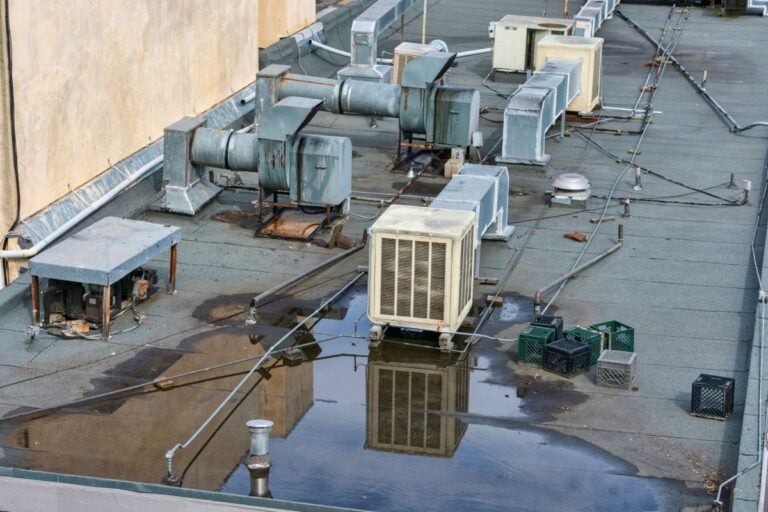
Flat and low-slope roofs are designed to drain, not to hold water. Ponding water — defined as standing water that remains on the roof surface 48 hours after a rain event — puts continuous hydrostatic pressure on the membrane, accelerates UV degradation, and adds structural load to the roof deck. In Florida, where heavy rain events are frequent and UV intensity is high, ponding water is one of the fastest ways to shorten a commercial roof’s service life. Clogged drains, compressed insulation, and inadequate slope are the most common causes and should be evaluated as part of any warehouse roof repair assessment.
3. Visible Membrane Blistering or Bubbling
Blistering occurs when moisture or air becomes trapped between the membrane and the substrate below it. On TPO, EPDM, or modified bitumen systems, blisters appear as raised, bubble-like formations across the membrane surface. Small blisters that are intact may not be causing immediate leaks, but they indicate adhesion failure that will worsen over time. Large blisters or blisters that have ruptured are active vulnerabilities that allow water infiltration and should be addressed through targeted warehouse roof repair before water reaches the insulation layer.
4. Failed or Deteriorated Flashing
Flashing is the metal or membrane material that seals transitions between the roof surface and vertical surfaces — parapet walls, HVAC curbs, skylights, vents, and pipe penetrations. It is also the most common entry point for water on commercial roofs. Sealants around flashing crack and shrink over time from UV exposure and thermal cycling. A major FM Global study found that 59 percent of built-up roof losses occurred because the roof perimeter failed — a figure that reflects just how consequential flashing integrity is. Lifting, separating, or cracked flashing anywhere on the roof warrants prompt warehouse roof repair before interior water damage occurs.
5. Seam Separation or Open Joints
Single-ply membrane systems like TPO and EPDM are installed in overlapping sheets with seams that are heat-welded or adhesive-bonded. Over time, thermal movement, poor original installation, or membrane shrinkage can cause seams to separate. An open seam is a direct water entry pathway that bypasses the membrane entirely. Seam repairs on TPO require professional heat-welding equipment and technique — improperly attempted repairs fail quickly. Any visible seam separation on a warehouse roof is an urgent repair item.
6. Sagging Roof Deck or Soft Spots
If walking on the roof surface produces a soft or spongy feeling underfoot, or if the roof deck shows visible deflection or sagging between structural members, the insulation or decking beneath the membrane has likely been saturated with moisture for an extended period. Wet insulation loses its R-value entirely, contributes to ongoing mold growth, and can compromise the structural integrity of the roof deck over time. This level of damage typically requires not just membrane repair but insulation replacement and potentially deck repair as well — and it escalates in scope and cost the longer it goes unaddressed.
7. Granule Loss or Surface Erosion on Modified Bitumen
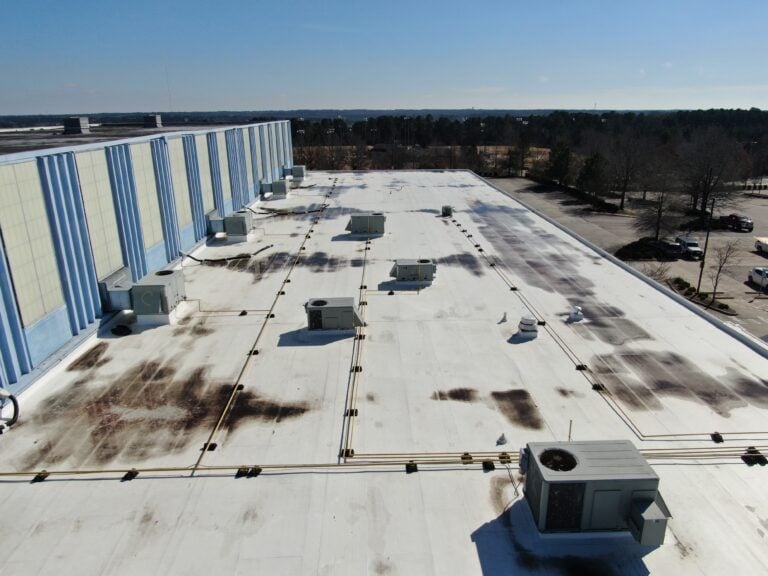
Modified bitumen roofing systems have a granule-surfaced cap sheet that protects the underlying asphalt layers from UV degradation. When granules wear away from foot traffic around HVAC equipment, weathering, or age, the exposed asphalt oxidizes and cracks. Widespread granule loss across a modified bitumen roof is a strong indicator that the system is approaching the end of its service life and that a coating system or targeted warehouse roof repair is needed to extend performance before full replacement becomes necessary.
Most Common Causes of Warehouse Roof Failure in Florida

Florida’s climate creates a specific set of roof failure conditions that property managers in the state should understand. These are the primary drivers of premature warehouse roof deterioration across northwest Florida.
- UV degradation: Florida’s intense, year-round UV exposure breaks down sealants, membrane surfaces, and elastomeric coatings faster than in most other climates. Products specified without Florida-grade UV resistance will fail ahead of schedule.
- Thermal cycling: The daily temperature swing between cool mornings and hot afternoons causes constant expansion and contraction of membrane systems and metal components. This stress is most damaging at seams, flashing terminations, and penetrations where movement is constrained.
- Hurricane and tropical storm wind loads: Wind-driven rain during storm events enters any compromised membrane, flashing gap, or open seam under pressure, pushing water further into the assembly than it would travel under normal rain conditions. Post-storm inspection is critical after every significant weather event.
- Standing water and drainage failures: Florida’s high rainfall volume combined with the common clogging of flat roof drains by debris creates persistent ponding conditions that accelerate all forms of membrane deterioration.
- HVAC equipment foot traffic: Warehouses typically carry significant rooftop mechanical equipment that requires periodic maintenance access. Repeated foot traffic without proper walkway protection causes membrane punctures, granule loss, and seam stress at equipment curbs.
Warehouse Roof Repair vs. Full Replacement
One of the most common questions property owners and facility managers face is whether a failing commercial roof should be repaired or replaced. The answer depends on the roof’s age, the extent of the damage, and whether the underlying insulation and deck are structurally sound.
| Factor | Repair Makes Sense | Replacement Makes Sense |
| Roof age | Under 15 years | 20+ years or at rated lifespan |
| Damage scope | Isolated areas, less than 25% of surface | Widespread membrane failure |
| Insulation condition | Dry and intact | Saturated or structurally compromised |
| Number of prior repairs | First or second repair event | Multiple repeated repairs at same locations |
| Estimated remaining life | 8-10+ years | Less than 5 years |
| Cost comparison | Repair under 30% of replacement cost | Repair approaching replacement cost |
As a general rule, if a commercial roof has more than 25 percent of its surface area damaged, has saturated insulation beneath the membrane, or has required repeated repairs at the same locations, replacement delivers better total value than continued patching. A professional roof assessment gives you the data to make that decision with confidence rather than guesswork.
What to Expect From the Warehouse Roof Repair Process

Understanding what a professional warehouse roof repair engagement looks like helps property managers set realistic expectations and evaluate contractor proposals.
- Initial inspection and moisture survey: A thorough assessment of a large commercial roof includes a visual inspection of the membrane, flashing, seams, drains, and penetrations. Infrared thermal imaging or electronic leak detection may be used to locate moisture within the insulation assembly that is not visible from the surface.
- Scope definition and proposal: A qualified contractor defines the repair scope specifically — which areas require patching, which seams need re-welding, which flashing sections require replacement — rather than offering a vague per-square-foot price. A detailed scope protects the building owner and ensures the repair addresses root causes rather than just symptoms.
- Surface preparation: The membrane surface must be thoroughly cleaned and primed before any patch or coating is applied. Skipping or rushing preparation is the most common cause of warehouse roof repair failures and callbacks.
- Repair execution: Depending on the membrane type, repairs may involve heat-welded TPO patches, EPDM splicing with contact cement and primers, torch-applied modified bitumen sections, or fluid-applied sealants and coatings over cleaned and primed surfaces.
- Post-repair inspection and documentation: A professional contractor provides written documentation of work completed, photos of repaired areas, and any recommendations for follow-up maintenance or monitoring. This documentation is also important for maintaining manufacturer warranty validity.
Frequently Asked Questions About Warehouse Roof Repair
Property managers and commercial building owners consistently ask the same practical questions when evaluating their options. Here are direct answers to the most common ones.
How much does warehouse roof repair typically cost in Florida?
Repair costs vary significantly based on the scope of damage, membrane type, and roof accessibility. Minor localized repairs — a single failed seam, a cracked flashing section, or a small membrane puncture — typically run in the hundreds of dollars. More significant repairs covering larger areas of membrane damage, flashing replacement, or insulation removal and replacement run into the thousands to tens of thousands. A full restoration coating system applied over a structurally sound but worn membrane on a large warehouse typically costs a fraction of full replacement while adding 10 to 15 years of service life.
Can warehouse roof repairs be done without shutting down operations?
In most cases, yes. Professional commercial roofing contractors are experienced in sequencing work to minimize disruption to warehouse operations below. The exception is large-scale repairs that require membrane tear-off over occupied or active areas, where temporary protection and operational coordination are part of the project plan. This is an important question to ask potential contractors during the bidding process.
How often should a warehouse roof be inspected in Florida?
The NRCA recommends a minimum of two professional inspections per year — one in spring and one in fall — plus an additional inspection after any significant storm event. In Florida, where hurricane season runs from June through November and UV exposure is year-round, this baseline schedule is especially important. Many property managers also schedule a pre-hurricane season inspection in May to confirm the roof’s condition before peak storm risk arrives.
What is the best commercial roofing material for Florida warehouse roofs?
TPO (thermoplastic polyolefin) is the most widely specified membrane system for new and replacement warehouse roofs in Florida. Its white reflective surface reduces cooling loads, its heat-welded seams create watertight bonds, and its resistance to UV, chemicals, and puncture make it well-suited to Florida’s climate and the operational demands of a warehouse environment. EPDM is also widely used and performs reliably in Florida conditions. Modified bitumen is more common on older existing systems and is typically maintained in place until replacement is warranted.
Is a roof coating a valid alternative to warehouse roof repair?
For roofs with sound underlying structure and insulation but a worn or degraded surface membrane, a fluid-applied roof coating system can be a cost-effective alternative to both traditional repair and full replacement. Coating systems extend membrane life by sealing small cracks and seam gaps, adding UV protection, and improving reflectivity. They work best when applied before the roof reaches a state of active widespread leaking — once insulation is wet or the deck is compromised, coating is not a substitute for proper remediation. A qualified inspector can determine whether your warehouse roof is a good candidate for a coating approach.
Quality Roofing Solutions: Commercial Roofing Done Right in Florida

Warehouse roof repair is not a task that rewards cutting corners or delaying decisions. Every month a compromised roof goes unaddressed, the scope of the damage expands — and so does the cost to fix it. At Quality Roofing Solutions, we have been assessing, repairing, and replacing commercial roofs across northwest Florida for over 20 years. We understand the specific failure modes that Florida’s climate produces, and we approach every commercial roof project with the same attention to detail we bring to residential work.
Whether you have an active leak that needs immediate attention or you want a professional condition assessment to plan ahead, our team is ready to help. Contact our team today to schedule your commercial roof inspection and get a clear, honest picture of what your warehouse roof needs right now.