 (850) 753-0041


Flat Roof Repair: Common Problems & How Pros Fix Them
September 12, 2026
10 minutes Read
Flat roof repair is one of the most frequently mishandled maintenance tasks in commercial and residential property ownership: not because the problems are complicated, but because flat roofs are ignored until a leaking flat roof forces the issue. By that point, what started as small cracks in a seam or a clogged drain has become a water-saturated insulation assembly requiring far more work than a simple patch repair. If your flat roof is showing signs of trouble, our commercial roofing team handles flat roof repair and restoration across northwest Florida. Here is what we cover:
- The 5 most common flat roof problems and how professionals repair a flat roof
- How to tell when repair is enough versus when roof replacement is the answer
- Common flat roofing materials and how repairability differs by type
- How flat roof repair costs are determined in Florida
- Frequently asked questions property owners commonly ask
Why Flat Roofs Require a Different Approach

Flat and low-slope roofs perform under a different set of stresses than a pitched roof. Without gravity shedding water, every element of the roof structure — slope, drainage, membrane, and flashing — must work together precisely. When any one fails, flat roof leaks follow.
According to NRCA field studies cited by The Roofing Brief, real-world flat roof failures across all five major membrane types concentrate in three predictable areas: ponding water, seam degradation, and detail flashing failures at penetrations and walls. That pattern holds across TPO, EPDM, rubber roof systems, modified bitumen, and built-up roofing regardless of climate, and it tells property owners exactly where to look first when a leaking roof develops.
We’re proud to serve home and business owners in DeFuniak Springs, FL, and nearby Walton County communities with flat roof repair and commercial roofing services built for Florida’s demanding climate.
5 Common Flat Roof Problems and How Pros Fix Them
Each problem below follows the same format: a brief overview of the issue, then the specific steps a professional takes to repair a flat roof correctly.
1. Ponding Water
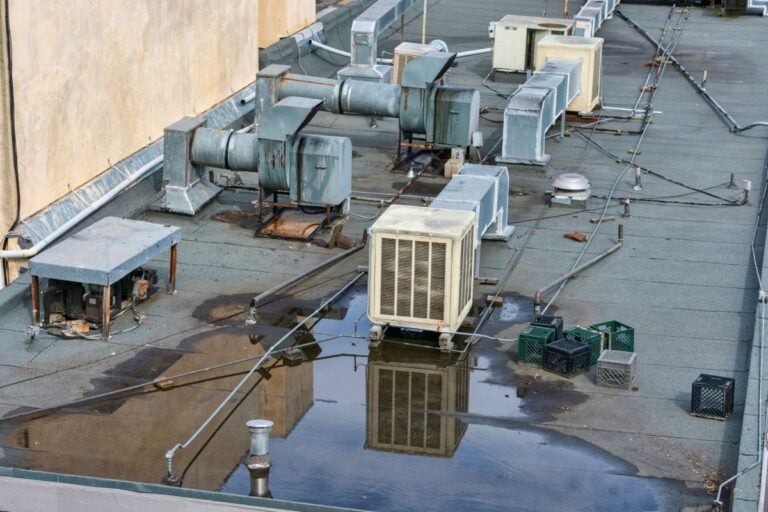
Ponding water, defined as standing water that remains on the roof surface more than 48 hours after rain, is the single largest cause of premature flat roof failure. It is excluded from virtually every major manufacturer’s warranty and accelerates UV degradation of any roof covering it touches.
- Check drains first: Clogged or undersized drains are the most common cause. Clearing and upgrading resolves ponding on otherwise sound roofs.
- Add tapered insulation: Compressed insulation that has lost its slope is corrected with tapered overlay to restore positive drainage.
- Cut out compromised sections: Where ponding has degraded the roof deck or membrane, affected sections are removed, wet insulation replaced, and the area re-membraned with proper slope correction.
2. Seam Separation and Open Joints
Seams are the most common active leak source on any flat roof. On TPO and PVC, improperly welded seams look intact but pop open within a few seasons. On rubber roof and EPDM systems, tape seam failures from inadequate prep are equally common. On modified bitumen, lap seam degradation from UV exposure is the dominant mode.
- TPO/PVC: Hot air welder applies a compatible cap strip over the failed seam. Adjacent seams are always probed since one failed weld rarely exists alone.
- Rubber roof/EPDM: EPDM seam tape with primer and roller pressure across the full repair length. Surface must be clean and dry.
- Modified bitumen: Torch-applied or cold-adhered patch repair using matching membrane material over the failed lap.
3. Flashing Failures at Penetrations
Detail flashing fails before field membrane on every flat roof type and in every climate, because field membrane gets the design attention and flashing gets whoever was available. Pipe boots, HVAC curbs, parapet wall transitions, and roof drain collars are all failure points where sealant cracks from thermal cycling and UV exposure. Using a roof repair kit on these areas produces a temporary result; professional replacement is what holds.
- Pipe boots: Replaced with new EPDM or metal boots compatible with the existing roof covering.
- HVAC curbs: Re-flashed with compatible membrane material, heat-welded or torch-applied to the field.
- Parapet walls: Re-terminated with membrane material, secured with termination bar and flat roof sealant. All adjacent penetrations are inspected when any one fails.
4. Blistering and Membrane Bubbling
Blisters form when moisture or air is trapped between the membrane and the roof deck during installation, or when heat drives existing moisture upward through the roof structure. Small intact blisters may not leak immediately, but they represent adhesion failure that worsens over time.
- Small blisters: Sliced to release trapped air or moisture, dried, primed, and re-covered with compatible patch repair material.
- Wet insulation below: The section is opened, wet insulation removed and replaced with new material before any membrane repair proceeds.
- Widespread blistering: A signal that replacement may be more cost-effective than individual patch repairs across multiple areas.
5. Drain and Drainage System Failures

Flat roofs depend on drains to move water before ponding begins. In Florida, where several inches of rain can fall in an hour, a marginal drain system fails under storm loading. Deteriorated drain collars that have separated from the membrane are a common source of flat roof leaks that appear right at the drain point, confusing owners who assume the drain is working because water is entering it.
- Clear blockages: Remove debris from the drain bowl and confirm flow through the drain body and downpipe. Gutters should be cleared annually at minimum to prevent flat roof leaks that develop when overflow backs up under the membrane edge.
- Replace collars: Deteriorated drain collars are replaced with compatible drains and clamping rings integrated into the membrane field.
- Upgrade capacity: Roofs with persistent overflow get additional drains or larger-diameter drain bodies to handle Florida rainfall volumes.
When to Repair vs. When to Replace
Not every leaking flat roof calls for full replacement. The decision comes down to how much of the surface is affected, whether the roof deck and insulation are sound, and how much membrane life remains.
| Condition | Repair | Replace |
| Isolated seam or flashing failure | Yes | No |
| Multiple failures across the roof | No | Yes |
| Ponding from clogged drains | Yes (fix drains first) | No |
| Ponding from failed insulation or slope | No | Yes |
| Wet insulation in isolated section | Repair with insulation replacement | No |
| Widespread wet insulation | No | Yes |
| Membrane at or past rated lifespan | No | Yes |
Common Flat Roofing Materials and How Repairability Differs
Not all common flat roofing materials repair the same way. Knowing your membrane type before calling a contractor saves time and ensures the right crew shows up with the right equipment.
- TPO: The most widely installed flat roof membrane in Florida. Reflective surfaces on TPO membranes can reduce cooling costs significantly in Florida’s heat, making it one of the most energy-efficient flat roof options. Repairs require a hot air welder; not every general contractor has one.
- EPDM / rubber roof: EPDM membranes can last over 50 years with proper care, making them one of the longest-lasting flat roofing options available. The easiest membrane to repair a flat roof with. Peel-and-stick patch systems and seam tape work well when applied correctly to a dry, primed surface.
- PVC: Requires hot air welding and matching membrane, which becomes harder to source on older roofs as product lines change.
- Modified bitumen/torch-on felt roof: Patch repair with a torch-applied or cold-adhered cap sheet is straightforward. Bitumen primer on the repair area improves adhesion significantly.
- Built-up roofing (BUR) / felt roof: Multi-ply construction means a single puncture does not leak immediately. Repairs involve hot asphalt or modified bitumen patch over the affected plies.
- Concrete flat roofs: A less common roof covering that typically requires specialist coatings rather than membrane patch repair. Liquid waterproofing can seal concrete roofs quickly in one coat, making it a practical first-response option for small crack and joint failures before a full protective coating system is applied.
What Drives Flat Roof Repair Cost in Florida
Repair costs vary based on membrane type, scope, and whether insulation or the roof deck needs work.
- Membrane type: TPO and PVC repairs cost more because of welding equipment and trained crew requirements. Rubber roof and modified bitumen repairs are more accessible.
- Scope: A single pipe boot or seam repair runs a few hundred to a few thousand dollars. Section repairs involving insulation removal scale significantly higher.
- Insulation condition: Wet insulation that must be removed adds material and disposal cost to any repair.
- Drain work: Collar replacement and capacity upgrades add scope when drainage failures are part of the problem.
Frequently Asked Questions About Flat Roof Repair

Flat roof owners ask the same practical questions before and after a leaking flat roof forces action. Here are direct answers.
Can I repair a flat roof myself?
Small patch repairs on accessible rubber roof or modified bitumen surfaces are DIY-possible with a roof repair kit for minor issues. However, any repair involving seam welding on TPO or PVC, flashing replacement at penetrations, or work on a roof with suspected wet insulation should be handled professionally. A poor patch repair on a flat roof often hides the problem long enough for secondary damage to develop below.
What is the best sealant for flat roof repair?
For penetration and flashing details, a compatible flat roof sealant (typically a polyurethane or silicone-based product rated for roofing use) is the right choice. Bitumen primer used before applying modified bitumen patches significantly improves adhesion on existing asphalt-based surfaces. Standard caulk and roofing cement are not suitable substitutes for membrane repair on commercial flat roofs: they fail under UV exposure and thermal cycling far faster than engineered roofing sealants.
How do I find a leak on a flat roof?
Flat roof leaks are notoriously difficult to trace because water travels horizontally through insulation before appearing inside. Start with the three most common failure points: seams, flashing at penetrations, and drain collars. Check these areas on the roof surface above and upslope from where the interior water appears. An infrared moisture scan identifies subsurface moisture in the insulation assembly and maps the full extent of water infiltration far more accurately than a visual inspection alone.
Is a new flat roof better than repeated repairs?
Flat roof repairs are often needed every 10 to 15 years as membranes age and sealants degrade, but a roof that requires repeated repairs in the same locations within a shorter window is telling you something. If a leaking roof has required three or more repairs in the same areas, or if the membrane is at or beyond its rated service life, a new flat roof typically delivers better total value than continued patching. Each patch repair on a degraded system addresses one failure while the surrounding membrane continues aging. A new flat roof resets the clock on the entire system — drainage, insulation, membrane, and flashing — under a manufacturer warranty.
Quality Roofing Solutions: Flat Roof Repair Done Right
Effective flat roof repair starts with an accurate diagnosis, not a bucket of sealant and a ladder. At Quality Roofing Solutions, we have been diagnosing and repairing leaking flat roofs across northwest Florida for over 20 years, with the commercial roofing experience to address the root cause rather than just the visible symptom.
Schedule your flat roof inspection and get a clear, honest assessment of what your roof actually needs.