 (850) 753-0041


Commercial Storm Damage: Response Steps for Property Owners
October 8, 2026
11 minutes Read
Commercial storm damage response is not the same process as residential recovery, and property owners who treat it the same way consistently leave money on the table, miss claim deadlines, and allow secondary damage to compound during the window between the storm and the contractor’s arrival. The stakes are higher, the documentation requirements are more rigorous, and the insurance process is more complex. Waiting even a few days makes storm damage worse. Getting the response sequence right from the first hours after a storm is what separates a claim that funds complete commercial storm damage restoration from one that drags on for months while the building continues to deteriorate. If your commercial property has sustained storm damage, our team that knows commercial roofs and what storms do to them is ready to help. Here is what we cover:
- Why commercial storm damage response requires a different approach
- 8 response steps for commercial property owners after a storm
- What commercial roof damage looks like and where to look first
- How the commercial insurance claim process differs from residential
- Frequently asked questions property owners and facility managers commonly ask
Why Commercial Storm Damage Is a Different Problem

The scale of commercial storm losses in the United States has crossed a threshold where it is no longer a periodic risk but a consistent operating reality. According to CNA Insurance citing the Insurance Information Institute, in 2025, severe convective storm-related insured losses reached $51 billion, marking the third consecutive year exceeding $50 billion, with total economic damages surpassing $68 billion. Hail accounts for up to 80 percent of severe convective storm claims, and roofs absorb a substantial portion of that loss.
For commercial property owners in northwest Florida, the threat is not just named hurricanes. Severe weather events including thunderstorms, wind events, hail, and tropical systems short of hurricane strength all produce roof damage that triggers complex claims, tenant disruption, and business interruption losses that dwarf the cost of the physical repairs. The response quality in the first 48 hours after a storm determines how much of that loss is recoverable.
We’re proud to serve home and business owners in Pensacola, FL, and nearby Escambia County communities with commercial storm damage assessment and roofing services that position property owners for the best possible recovery outcome.
8 Steps Commercial Property Owners Should Take After Storm Damage
The response sequence matters. Each step builds on the one before it, and skipping or reordering them creates gaps in documentation, timeline, and claim support that are difficult to recover later.
1. Confirm Building Safety Before Reentry
Before anyone enters the building, confirm that the structure is safe to occupy. Wind events can compromise load-bearing elements that are not visible from the exterior. Check for downed power lines, gas odors, standing water near electrical panels, compromised electrical systems, and any visible roof section that appears to have shifted, collapsed, or lost structural support. If the damage is severe or the scope is unclear, a structural engineer or licensed contractor should assess safety before staff or tenants are allowed back in.
- Document the exterior from a safe distance before any cleanup begins
- Notify tenants of the safety assessment status and expected timeline for reentry
- Contact utilities if any service lines appear damaged or compromised
2. Protect the Property From Further Loss
Once safety is confirmed, immediate steps to prevent additional damage are both operationally necessary and legally required under most commercial property policies. Insurers can deny coverage for damage that occurred after the storm if they determine the property owner failed to take reasonable protective action.
- Install emergency tarps over any open roof sections before the next rain event
- Board up any window or wall openings created by the storm
- Extract standing water from interior spaces using wet-dry vacuums or professional extraction equipment, then begin structural drying of any wet wall and ceiling assemblies promptly. Mold can start forming within days after water damage in Florida’s warm, humid climate, making moisture removal as time-sensitive as the roof repair itself
- Document all temporary protection with timestamped photographs before and after
3. Document Everything Before Cleanup
Date-stamped documentation of every damage point, from the exterior roofline to the interior ceiling and contents, is the foundation of a commercial storm damage claim. This documentation must be captured before any debris removal, repair work, or cleanup activity changes the evidence.
- Photograph and video every slope of the roof, all four building elevations, every interior space affected, and all contents damage
- Note the storm date and collect any NOAA or National Weather Service data confirming the wind damage or severe weather event in your area
- Record all temporary protection costs including materials and labor for the insurer
4. Notify Your Insurance Carrier and Review Policy Terms
File notice of the claim with your insurance company as soon as temporary protection is in place. Before speaking with the adjuster, review the key provisions of your policy.
- Deductible structure: Commercial policies often carry percentage-based deductibles for wind and named storm events rather than fixed-dollar amounts. On a $2 million building with a 2 percent wind deductible, that is $40,000 out of pocket before coverage begins.
- Business interruption coverage: Confirm whether your policy includes business interruption or extra expense coverage, which pays for lost income and additional operating costs during the repair period.
- Filing deadline: Commercial storm damage claims typically must be filed within one year of the date of loss for hurricane events in Florida, and within two years for non-hurricane storm events.
5. Schedule a Professional Commercial Roof Inspection

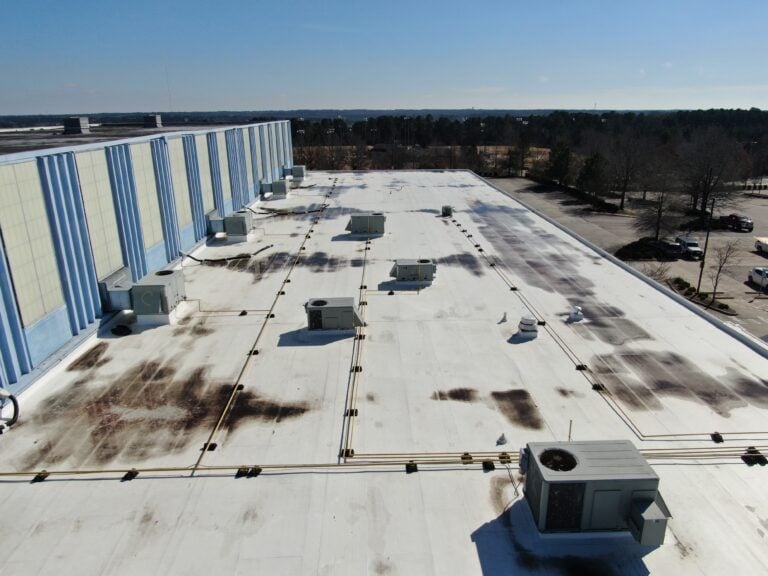
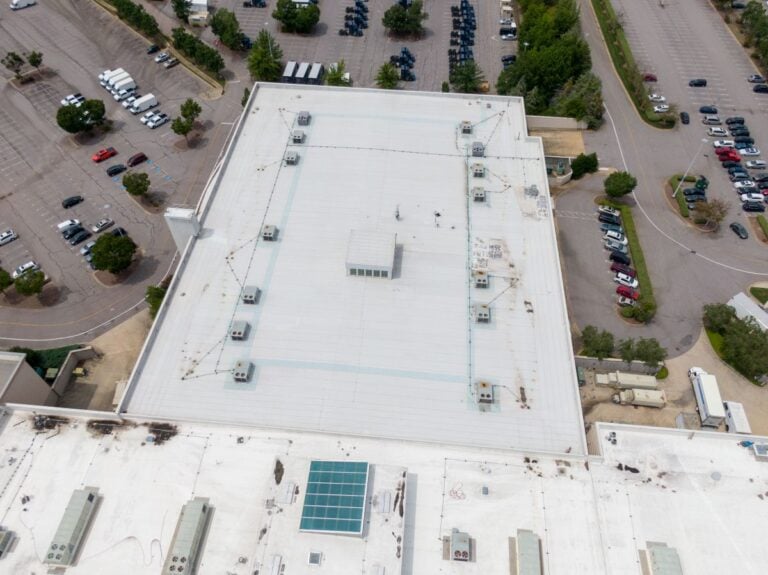
A licensed commercial roofing contractor should conduct a thorough inspection of the full roof system before the insurance adjuster arrives. Drones are used for comprehensive aerial surveys of storm damage on large commercial roofs, providing photographic coverage of every section without the safety risks of walking a potentially compromised surface. The inspection must be methodical and documented, covering every aspect of the roof system rather than just the most visible damage.
- Membrane surface: Hail can damage roofing membranes across the full field, leaving impact punctures, tears, and bruising that may not be immediately visible but allow moisture intrusion over time
- Flashing and penetrations: HVAC curbs, pipe boots, parapet walls, drains, and all roof-to-wall transitions
- HVAC equipment: Hail can damage HVAC systems on the rooftop, including condenser fins, electrical components, and refrigerant lines. Inspect all rooftop units for impact damage alongside the membrane inspection
- Drainage: Drain bowls, drain collars, and any interior drain lines compromised by debris or structural movement
- Decking and insulation: Areas where the membrane has been breached and moisture has entered the assembly
6. Meet the Insurance Adjuster With Your Contractor Present
Your commercial roofing contractor should be present during the adjuster’s inspection. Commercial adjuster visits cover large, complex roof systems quickly, and damage that is not walked and documented together during the adjuster visit becomes a supplement dispute rather than a covered item in the initial estimate.
- Walk every section of the roof with the adjuster rather than allowing an unaccompanied inspection
- Reference your contractor’s documentation at each damage point during the walkthrough
- Confirm interior damage is included in the adjuster’s scope, not just the exterior roof surface
7. Review the Adjuster’s Estimate Before Accepting
Commercial adjuster estimates frequently undervalue restoration scope, use outdated unit pricing, or omit line items that your contractor’s assessment includes. The supplement process is the mechanism for resolving those gaps.
- Compare line by line against your contractor’s detailed scope of work
- Identify missing items: Code upgrade requirements, insulation replacement, drain collar replacement, and interior repairs tied to the roof breach are commonly omitted
- Do not sign a release or accept a settlement until your contractor has reviewed and confirmed the estimate is sufficient to complete a code-compliant restoration
8. Complete Permitted Restoration Work
Any commercial building roof repair or replacement in Florida requires a building permit in most jurisdictions. Permitted work is inspected by the building department and produces a final inspection record that protects warranty coverage, satisfies insurance documentation requirements, and protects against future coverage disputes about the quality and scope of the repair.
- Confirm materials meet current Florida Building Code wind resistance and product approval requirements
- Document the restoration with photographs at each stage, deck condition, underlayment or membrane installation, flashing installation, and completed surface
- Collect closeout documentation: Permit final inspection record, manufacturer warranty registration, and contractor workmanship warranty
What Commercial Roof Storm Damage Looks Like
Commercial roof damage from storms presents differently than residential damage, and knowing what to look for helps property owners triage the scope and communicate clearly with contractors and adjusters.
| Damage Type | Storm Cause | Where to Look |
| Membrane puncture or tear | Hail impact, flying debris | Full membrane field, especially low-slope areas |
| Seam separation | Wind damage and thermal movement post-storm | All field and perimeter seams |
| Flashing displacement | Wind uplift at edges and transitions | HVAC curbs, parapet walls, drains |
| Gravel ballast displacement | High wind | Any ballasted EPDM or modified bitumen system |
| Ponding from blocked drains | Debris accumulation | All roof drains and scuppers |
| Interior water intrusion | Any roof breach | Ceiling tiles, insulation, tenant spaces below |
| Fascia and coping cap damage | Direct wind impact | All roof perimeter edges |
Frequently Asked Questions About Commercial Storm Damage
Property owners and facility managers navigating commercial storm damage tend to have the same practical questions. Here are direct answers to the most common ones.
How quickly do I need to respond after commercial storm damage?

Immediately. The 48-hour window after a storm is critical for two reasons: preventing additional water intrusion through open areas before the next rain event, and establishing documentation before anything changes. Florida commercial property policies require property owners to take reasonable steps to mitigate further loss, and carriers use failure to act promptly as a basis for reducing or denying coverage on secondary damage.
Does commercial property insurance cover business interruption from storm damage?
It depends on whether your policy includes business interruption or extra expense coverage, and whether the physical damage is covered under the policy. If the commercial storm damage creates a covered loss and the property cannot be fully occupied or operated during restoration, business interruption coverage pays for the income loss and additional operating costs during the repair period. This coverage has waiting period provisions that vary by policy, and the claim must be supported by financial records that document the actual income loss.
How is a commercial storm damage claim different from a residential one?
Commercial claims involve larger physical scope, multiple tenants with independent interests, more complex policy structures, longer claim timelines, and stricter documentation requirements. The insurance adjuster on a commercial claim typically has less time per property and covers more damage points per visit than on a residential claim. Having a contractor present during the adjuster visit and a complete written inspection report available before the adjuster arrives are more critical on commercial claims than residential ones.
When does storm damage require full commercial roof replacement rather than repair?
The standard threshold is 25 percent of the roof surface affected by damage or moisture intrusion. Below that threshold, targeted repairs are typically appropriate. Above it, full replacement often delivers better long-term value and may be required under Florida Building Code if certain code upgrade thresholds are triggered. An infrared moisture survey is the most reliable way to establish the actual extent of damage, including subsurface moisture that is not visible from the surface inspection.
Can I use any contractor for commercial storm damage repair in Florida?
No, commercial roof repair and replacement in Florida must be performed by a licensed contractor. The license requirement for commercial work is a Florida Certified Roofing Contractor license or the equivalent for the specific work being performed. A contractor who is not licensed for commercial work cannot pull the required permits, and unpermitted commercial roof work creates significant liability and coverage complications for the property owner. Verify the Florida license at myfloridalicense.com before signing any contract.
Quality Roofing Solutions: Commercial Storm Damage Recovery Across Northwest Florida
Commercial storm damage recovery is a process, not a transaction, and the outcome at every stage, safety assessment, documentation, insurance claim, and permitted restoration, depends on having an experienced commercial roofing contractor who understands the full scope of what the process requires. At Quality Roofing Solutions, we have been delivering storm damage restoration services to commercial property owners across northwest Florida for over 20 years, with the commercial licensing, the inspection process, and the insurance documentation experience that complex commercial claims demand.
Get your post-storm assessment started before the next rain event tests what the storm left behind.